
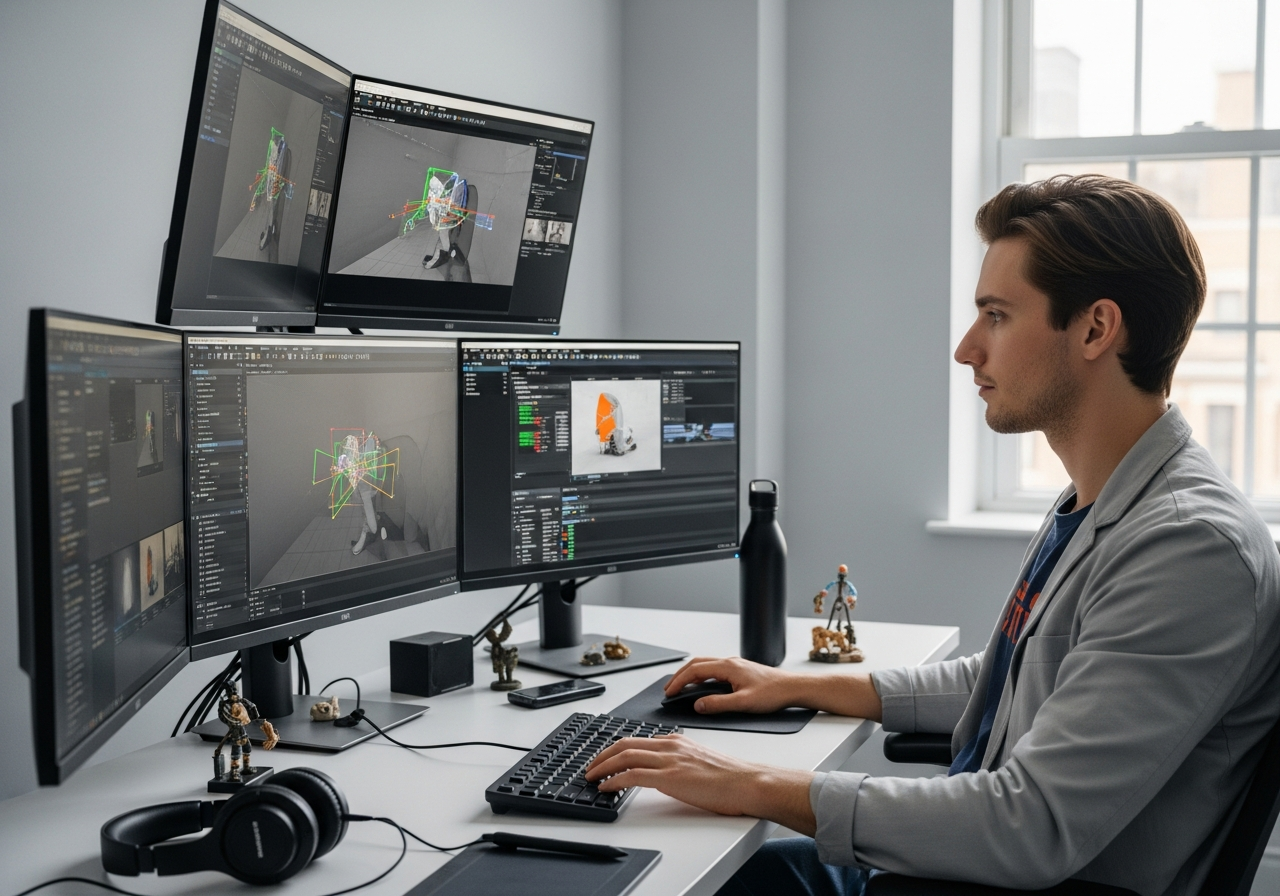
Canada’s VFX industry thrives in major hubs like Vancouver and Montreal, where studios constantly seek talented junior matchmove artists with 0-2 years of experience. These entry-level positions focus heavily on portfolio strength over traditional resume credentials, making your demo reel and technical demonstrations the primary factors in landing your first role.
Canadian employers prioritize candidates who demonstrate proficiency in industry-standard software like Maya and 3D Equalizer, along with clean tracking solutions that show attention to detail. Your portfolio becomes your strongest asset, showcasing not just technical skills but also your ability to solve real-world VFX challenges that studios face daily.
Essential Technical Skills for Your Portfolio
Canadian VFX studios analyze junior portfolios for specific technical competencies that translate directly to production work. Your demonstrations should focus on clean solve quality over complex shots, proving you understand fundamental tracking principles that form the backbone of professional matchmove work.
Job postings from Vancouver and Montreal studios consistently emphasize core software proficiency and reliable tracking results. Junior artists must show they can handle basic camera solves and object tracking without requiring extensive supervision or rework from senior team members.
- Maya matchmove module proficiency with clean camera solves and accurate 3D positioning
- 3D Equalizer fundamentals including lens distortion correction and solve optimization
- PFTrack basic operations for alternative workflow demonstrations
- Nuke integration skills showing seamless handoffs between tracking and compositing
- Clean plate analysis and feature point selection for reliable tracking results
- Basic scripting knowledge for workflow efficiency and batch processing tasks
- Understanding of camera metadata and lens information for accurate reconstructions
Must-Have Software Demonstrations
Your portfolio must include concrete examples of software proficiency through actual tracking work rather than theoretical knowledge. Canadian employers want to see solve statistics, before-and-after comparisons, and evidence of clean technical execution across multiple platforms.
| Software | Portfolio Example | Why Canadian Employers Care |
|---|---|---|
| Maya | Camera track with sub-pixel error rates and wireframe overlays | Industry standard for most Vancouver studios |
| 3D Equalizer | Lens distortion solve with deviation graphs and statistics | Preferred for complex tracking at major facilities |
| PFTrack | Basic handheld solve with feature tracking breakdown | Alternative workflow knowledge shows versatility |
| Nuke | Integrated comp showing tracked elements in final shot | Pipeline integration essential for production work |
| SynthEyes | Object tracking with animated geometry placement | Budget-friendly alternative used by smaller studios |
| After Effects | 2.5D tracking for motion graphics integration | Useful for commercial and broadcast projects |
Tracking Principles to Showcase
Fundamental tracking knowledge forms the foundation of every successful matchmove artist’s career. Canadian studios expect junior artists to understand core principles like focal length relationships, lens distortion characteristics, and how camera movement affects tracking point selection and solve stability.
Your portfolio should demonstrate practical application of these principles rather than academic understanding. Show how you handle common tracking challenges like motion blur, poor lighting conditions, or limited feature points by using proper technique and tool selection.
Focus on junior-level demonstrations that prove competency without overreaching into advanced territory. Clean, simple tracks with detailed explanations often impress employers more than complex shots with obvious technical problems or shortcuts.
Ideal Portfolio Structure and Demo Reel
Your demo reel serves as the first impression for Canadian VFX studios, requiring careful curation to showcase progression from simple to complex shots. Keep the reel between 30-60 seconds with 4-8 shots that demonstrate increasing difficulty while maintaining clean technical execution throughout.
Include before-and-after visuals that clearly show your tracking work, accompanied by solve statistics and wireframe overlays that prove accuracy. Avoid watermarks that cover your actual work, as employers need to evaluate tracking quality and technical precision without visual obstruction.
Structure your portfolio website with clear navigation between different shot types and technical demonstrations. Canadian employers often review portfolios quickly, so intuitive organization and fast loading times become crucial for keeping their attention focused on your work quality.
Professional presentation extends beyond the reel itself to include detailed breakdowns, contact information, and technical specifications for each shot. This comprehensive approach shows employers you understand production requirements and can communicate effectively with team members and supervisors.
Shot Selection and Breakdowns
Strategic shot selection demonstrates your understanding of different tracking challenges while showcasing technical growth from basic to intermediate complexity. Each shot should serve a specific purpose in proving your capabilities to Canadian studio hiring managers.
Detailed breakdowns help employers understand your problem-solving approach and technical methodology. Include step-by-step documentation that shows how you approached each challenge, what tools you selected, and why your solution works effectively for production requirements.
- Start with a clean static camera track showing perfect solve accuracy and wireframe alignment
- Progress to handheld camera movement demonstrating feature point selection and solve optimization
- Include object tracking with simple geometry placement and accurate motion matching
- Show lens distortion correction with before-and-after comparison and statistical validation
- Demonstrate integrated compositing work showing tracked elements in final rendered shot
- End with your most complex shot showcasing advanced techniques while maintaining clean execution
Key Shot Types Canadian Studios Expect
Canadian VFX studios work on diverse projects requiring specific shot types that appear consistently in junior matchmove artist job requirements. Your portfolio should demonstrate competency across these common scenarios while maintaining appropriate complexity levels for entry-level positions.
| Shot Type | Complexity (Junior) | Example from Canadian Jobs |
|---|---|---|
| Static Camera | Basic | Set extension for practical location shoots |
| Handheld Movement | Intermediate | Documentary-style footage with natural camera shake |
| Dolly/Zoom | Intermediate | Controlled camera moves for creature integration |
| Object Tracking | Basic-Intermediate | Props replacement for period drama productions |
| Puppet Animation | Intermediate | Character animation reference for digital doubles |
Camera Track Examples
Clean camera tracking forms the foundation of most VFX work, making this skill set absolutely essential for junior positions in Canadian studios. Your portfolio should demonstrate consistent accuracy across different camera movement types while showing proper feature point selection and solve optimization techniques.
Focus on handheld tracking examples that show natural camera movement with accurate reproduction of subtle shake and drift. Overlay your solved cameras on the original plates using wireframes or simple geometry to prove tracking accuracy and demonstrate professional presentation standards.
Object and Prop Animation
Object tracking skills become increasingly important as Canadian studios work on productions requiring practical prop replacement and digital asset integration. Show your ability to track moving objects through space while maintaining accurate position, rotation, and scale relationships to the original filmed elements.
Demonstrate matchmove work for puppets or modeled debris based on live-action reference plates, proving you can handle the tracking challenges common in creature work and destruction sequences. These examples show employers your readiness for diverse project types typical in Canadian VFX production.
Soft Skills and Professionalism in Portfolios
Technical proficiency alone doesn’t guarantee success in Canadian VFX studios, where collaborative teamwork and deadline management become equally important for junior artists. Your portfolio presentation should reflect professional communication skills and attention to detail that employers expect in production environments.
Organize your portfolio with clearly labeled shots, comprehensive contact details, and intuitive navigation that respects busy hiring managers’ time. Professional presentation demonstrates your understanding of client-facing work and ability to represent the studio effectively when communicating with external collaborators.
Canadian studios value problem-solving attitude and willingness to learn from feedback, qualities that should emerge through your portfolio organization and shot selection. Show progression in your work quality and demonstrate how you’ve addressed technical challenges through improved methodology and tool usage.
- Clear project organization with labeled shots and technical specifications
- Comprehensive contact information including professional email and phone number
- Evidence of collaborative work through team project credits and shared responsibilities
- Deadline awareness shown through completed personal projects and consistent quality standards
- Problem-solving documentation explaining how you overcame technical challenges
- Professional presentation matching industry standards for portfolio websites and demo reels
Communicating Your Process
Detailed process documentation sets junior candidates apart by showing employers your analytical thinking and technical communication skills. Include written explanations of solve challenges you encountered and how you addressed them using specific tools and techniques.
Create PDF breakdowns for your most complex shots that walk through your methodology step-by-step, including software settings, feature point selection criteria, and optimization techniques. This level of documentation proves you understand the reasoning behind your technical choices rather than just following tutorials.
Professional communication extends to how you present technical information, using appropriate VFX terminology and clear visual aids that help employers quickly assess your competency level. Strong communication skills become essential when working with supervisors and handling client feedback in production environments.
Common Portfolio Mistakes to Avoid
Junior matchmove artists often sabotage their job prospects through preventable portfolio mistakes that immediately signal inexperience to Canadian studio hiring managers. Understanding these common pitfalls helps you avoid eliminating yourself from consideration before employers even evaluate your technical skills.
| Mistake | Why It Hurts | Fix |
|---|---|---|
| Messy tracking points | Shows poor attention to detail and unprofessional workflow | Clean up tracks before rendering, organize feature points logically |
| Missing solve statistics | Employers can’t verify tracking accuracy or technical competence | Include error rates and deviation graphs with every example |
| Poor shot selection | Irrelevant examples don’t demonstrate production-ready skills | Focus on shot types common in Canadian studio job postings |
| Incomplete breakdowns | Employers can’t assess problem-solving skills or methodology | Document process steps and technical decisions for each shot |
| Overly complex shots | Junior-level positions don’t require advanced techniques | Emphasize clean execution over complexity for entry-level roles |
Technical Pitfalls
Technical execution problems immediately reveal inexperience and poor training to Canadian studio supervisors. Focus on achieving consistent quality across all portfolio examples rather than attempting advanced techniques that exceed your current skill level.
- High error rates in solve statistics indicating poor feature point selection or optimization
- Ignoring lens distortion correction leading to inaccurate camera reconstruction and geometry placement
- Single-pass tracking without refinement showing lack of quality control and professional standards
- Poor wireframe presentation that doesn’t clearly demonstrate tracking accuracy to employers
- Missing metadata integration causing pipeline compatibility issues in production workflows
Presentation Errors
Professional presentation mistakes can eliminate otherwise qualified candidates from consideration at Canadian studios. Employers expect junior artists to understand basic professional standards for portfolio organization, contact information, and visual presentation quality.
Disorganized portfolio layouts make it difficult for hiring managers to quickly assess your skills during busy review periods. Include clickable resume links, clear navigation between different shot types, and comprehensive contact details that make it easy for employers to reach you for interviews or additional information.
Canadian-Specific Tips and Next Steps
Vancouver and Montreal dominate Canada’s VFX landscape, with each city offering distinct opportunities for junior matchmove artists. Vancouver studios often focus on big-budget feature films and television series, while Montreal combines film work with significant gaming and animation projects requiring diverse skill sets.
Target your job search using platforms like Talent.com and BuiltInVancouver, which frequently list VFX positions from major Canadian studios. Work eligibility becomes crucial for international candidates, as most studios require legal authorization to work in Canada before considering applications from foreign artists.
Network within the Canadian VFX community through local meetups, online forums, and industry events in Vancouver and Montreal. Many junior positions come through referrals and internal recommendations, making professional connections as important as portfolio quality for landing your first role.
Consider the seasonal nature of VFX work in Canada, where production schedules often align with film and television industry cycles. Plan your job search timing around these patterns, and be prepared for contract-based employment that requires flexibility and adaptability to different studio cultures and project requirements.
Tailoring for Top Studios
Major Canadian studios have specific preferences and technical requirements that should influence your portfolio development and application strategy. Research each studio’s recent projects and technical pipeline to understand what skills and shot types they value most in junior candidates.
Customize your portfolio presentation and cover letter for each application, highlighting relevant experience and technical skills that match the studio’s current project needs. This targeted approach shows employers you’ve researched their company and understand their production requirements.
| Studio | Key Portfolio Focus | Application Tip |
|---|---|---|
| Scanline VFX | Complex camera work and destruction sequences | Emphasize clean tracking under challenging conditions |
| SpinVFX | Motion capture integration and character work | Show object tracking and puppet animation examples |
| DNEG | High-end feature film tracking standards | Include detailed solve statistics and professional presentation |
| Atomic Fiction | Set extensions and environmental work | Focus on architectural tracking and static camera work |